KIDS & EDUCATION · 13 MIN READ
Tinkerer Box Review: The Fun STEM Subscription Box That Turns Learning Into an Adventure
Aug 09, 2026 · 11K views
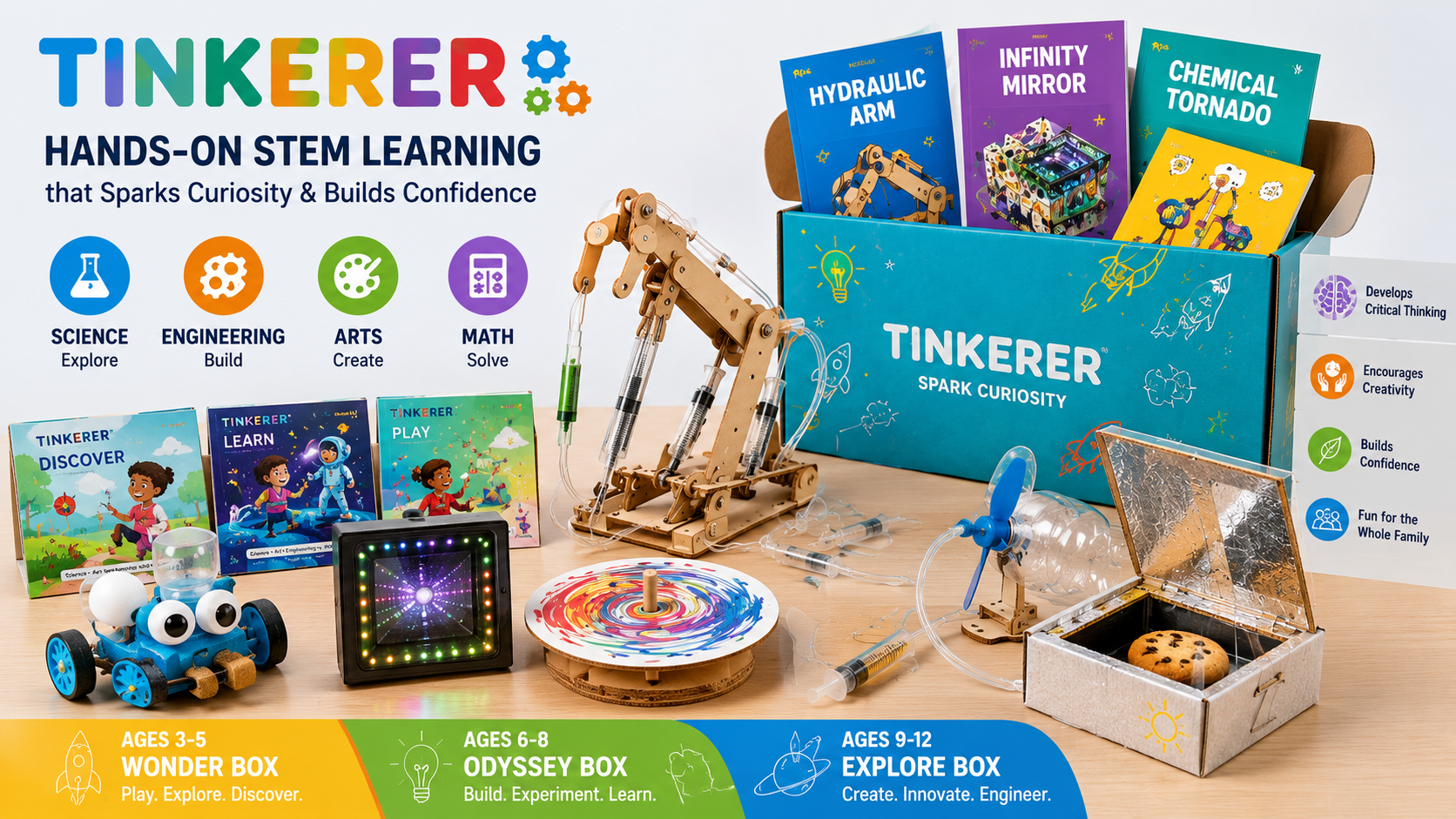
What if a child could learn about engineering by building a hydraulic arm, explore physics by launching a catapult, discover the science of light through an infinity mirror, or learn mathematics while playing with a pretend grocery store?
That's the idea behind Tinkerer Box.
Instead of simply giving children something to watch or read, Tinkerer creates hands-on projects that encourage kids to build, experiment, solve problems, and discover how things work.
The result is a very different kind of learning experience.
It's educational.
But it also feels like play.
And that's exactly what makes Tinkerer interesting for parents searching for meaningful activities that can keep children curious and engaged.
What Is Tinkerer Box?
Tinkerer is a STEM and STEAM learning platform that delivers hands-on activity boxes designed around children's ages and developmental stages.
Its current subscription lines are divided into three main groups:
-
Wonder Box — Ages 3–5
-
Odyssey Box — Ages 6–8
-
Explore Box — Ages 9–12
Each line introduces children to age-appropriate activities combining creativity, experimentation, science, technology, engineering, arts, and mathematics.
Instead of giving children a finished toy, Tinkerer encourages them to make something themselves.
That difference is important.
The child isn't simply pressing a button and watching something happen.
They're involved in the process.
Why Tinkerer Box Is Different From Ordinary Toys
Parents often face a familiar problem.
A child receives a new toy.
They're excited.
They play with it for a few days.
And then?
It ends up sitting on a shelf.
Tinkerer takes a different approach.
The activity itself becomes the experience.
Children receive materials and instructions that guide them through a project, allowing them to build, experiment, play, and learn along the way.
The official Tinkerer website describes its philosophy as "learn through play", with hands-on assembly, experimentation, games, quizzes, and problem-solving activities designed to encourage curiosity and confidence.
That's what makes the concept particularly appealing.
The child isn't simply consuming entertainment.
They're actively creating something.
Tinkerer Wonder Box for Ages 3–5
The Wonder Box is designed for younger children between 3 and 5 years old.
At this stage, learning works best when it feels playful and tangible.
Instead of complicated scientific explanations, Tinkerer introduces early learning concepts through imaginative activities.
Some examples currently featured by Tinkerer include:
-
Mini-Market
-
Pizza Maths
-
Castle and Catapult
-
Music
These activities combine pretend play, basic mathematics, creativity, movement, and simple scientific concepts.
For example, the Pizza Maths project can introduce children to counting, fractions, and patterns through a playful pizza-themed activity.
The Mini-Market project combines pretend shopping with early mathematics.
This is a clever approach because children can learn without feeling like they're sitting through a lesson.
Tinkerer Odyssey Box for Ages 6–8
As children grow, their activities become more sophisticated.
The Odyssey Box is designed for children aged 6–8 and introduces more advanced science and art concepts.
Current examples include:
Spy Academy
Children explore codes, navigation, hidden messages, and spy-themed gadgets.
Ultraviolet Light
Children create a UV lighting experience while exploring invisible light and energy.
Spin Art
A hands-on project introduces motion, patterns, and centrifugal force through creative spin art.
Polarisation
Children explore light filters and discover how polarization affects the way light travels and appears.
This combination is particularly appealing because the activities aren't limited to one academic subject.
Science and creativity work together.
Tinkerer Explore Box for Ages 9–12
For older children, Tinkerer moves into more advanced science and engineering.
The Explore Box is designed for ages 9–12.
This is where the projects become especially interesting for kids who enjoy building and figuring out how things work.
Current examples include:
-
Hydraulic Arm
-
Bubble Robot
-
Chemical Tornado
-
Infinity Mirror
-
Air Engine
-
Automaton
These projects introduce concepts from engineering, mechanics, chemistry, physics, and optics through hands-on experimentation.
A child might build a hydraulic arm and discover how fluid pressure can create movement.
Or create an infinity mirror and explore reflection and optical illusions.
Or build an air engine and investigate the Bernoulli principle.
Suddenly, a scientific concept isn't just something written in a book.
It's something the child can actually see and manipulate.
What Comes Inside a Tinkerer Box?
One of the most appealing aspects of Tinkerer is that the projects are designed as complete experiences.
The Explore Box, for example, includes:
-
Building materials
-
A science magazine
-
Graphic instructions
-
Online instructional videos
The box is structured around a Make → Play → Learn experience.
That means children aren't simply handed a pile of materials and told to figure everything out.
They receive guidance while still having an opportunity to experiment.
Tinkerer Makes STEM More Hands-On
STEM education can sometimes feel abstract.
A child may hear about:
Gravity.
Pressure.
Electricity.
Light.
Motion.
Engineering.
But understanding a concept becomes much easier when they can physically interact with it.
That's the strength of hands-on learning.
Instead of simply explaining how a hydraulic system works, a project can allow a child to build one.
Instead of talking about optical illusions, they can create an infinity mirror.
Instead of explaining force and motion, they can build and launch a catapult.
Tinkerer turns concepts into experiences.
Learning Through Play
The philosophy behind Tinkerer is simple:
Children learn better when they are genuinely interested in what they're doing.
The company's educational approach emphasizes exploration, experimentation, creativity, and problem-solving rather than passive learning.
That can be particularly valuable for children who don't naturally enjoy traditional studying.
A child who doesn't want to read a page about physics might be extremely excited to build something that demonstrates physics in action.
And once curiosity appears, learning becomes much easier.
Tinkerer Box Encourages Problem-Solving
Building something rarely goes perfectly on the first attempt.
A component might not fit.
A mechanism might not move.
A structure might collapse.
A child might have to try again.
That process is valuable.
Instead of immediately giving up, children can learn to ask:
Why didn't it work?
What can I change?
What happens if I try another approach?
These are important problem-solving habits that extend far beyond STEM.
They can help children become more comfortable with experimentation and failure.
Tinkerer and Creative Confidence
One of the most interesting goals behind Tinkerer is developing creative confidence.
The company says its boxes are designed to encourage children to become curious explorers who are willing to face challenges and find their own solutions.
That is an important distinction.
Education isn't only about getting the correct answer.
It's also about becoming comfortable with questions.
What if I try this?
Can I make it better?
Why does this happen?
What happens next?
Those questions are the foundation of genuine curiosity.
Tinkerer Box for Curious Kids
Some children naturally want to take things apart.
They want to know how machines work.
They love building things.
They ask endless questions.
They enjoy experiments.
For those children, a STEM subscription box can be particularly exciting.
Instead of waiting for the next school science project, they can have a new hands-on challenge arriving at home.
This gives parents another way to encourage curiosity outside the classroom.
Tinkerer for Parents Who Want Screen-Free Activities
Screens are everywhere.
Children use them for entertainment, schoolwork, communication, and games.
That doesn't mean screens are necessarily bad.
But many parents still want activities that encourage children to step away from a device.
Tinkerer can fit naturally into that routine.
A child can sit down at a table and spend time:
-
Building
-
Drawing
-
Testing
-
Experimenting
-
Reading
-
Solving
-
Creating
The result is an activity that feels productive without feeling like additional homework.
Tinkerer Box for Family Time
Another advantage is that parents don't necessarily have to leave children completely on their own.
A project can become a shared activity.
A parent can ask:
"Why do you think that happened?"
"What happens if we change this?"
"Can you make it move faster?"
"Can you build another version?"
This turns the box into more than an educational product.
It becomes an opportunity for conversation and collaboration.
STEM Meets Art
One thing that makes Tinkerer particularly interesting is that it doesn't treat STEM as completely separate from creativity.
Its activities include elements of STEAM, adding arts to science, technology, engineering, and mathematics.
This can be seen in projects such as Spin Art, Infinity Mirror, Music, and other creative experiments.
That's useful because creativity and technical thinking aren't opposites.
In real life, designers, engineers, architects, scientists, and inventors constantly combine both.
Tinkerer Box and Engineering
Older children's Explore projects provide particularly strong opportunities for engineering-related learning.
Take the Hydraulic Arm project.
A child can build a working mechanism and observe how fluid pressure produces movement.
That's a much more memorable experience than simply reading a definition of hydraulics.
The same idea applies to the Automaton and Air Engine projects.
Children are introduced to mechanical principles by actually creating something that moves or works.
Tinkerer Infinity Mirror
The Infinity Mirror is one of the most visually exciting projects in the Tinkerer collection.
The project uses mirrors and lights to create the appearance of an endless tunnel of reflections.
Children can explore:
-
Reflection
-
Light
-
Optical effects
-
Mirrors
-
Visual perception
But there's also an artistic element.
The final result is something they can display.
That makes the project especially satisfying because the child doesn't simply finish an experiment.
They create something they can actually show other people.
Tinkerer Hydraulic Arm
The Hydraulic Arm is another excellent example of the company's hands-on philosophy.
Rather than simply explaining pressure and mechanical movement, the project lets children build a working hydraulic system.
They can see how pressure moves components and creates controlled movement.
This type of activity can be particularly engaging for kids interested in:
-
Engineering
-
Machines
-
Robotics
-
Construction
-
Mechanics
Tinkerer Bubble Robot
Robots are naturally exciting to many children.
The Bubble Robot project combines a playful result with an opportunity to explore air pressure and simple mechanics.
That's a smart educational combination.
The child isn't simply learning a concept.
They're making something fun happen.
And fun is often what keeps curiosity alive.
Tinkerer Chemical Tornado
The Chemical Tornado project introduces children to chemistry through a visually engaging experiment.
Watching a swirling chemical reaction happen can turn abstract ideas about acids, bases, and reactions into something much easier to remember.
Of course, experiments involving chemicals should always be completed according to the supplied instructions and with appropriate adult supervision.
Tinkerer for Different Ages
One of the strengths of the Tinkerer model is its age segmentation.
Ages 3–5
Wonder Box
Focuses on early learning, pretend play, creativity, and basic concepts.
Ages 6–8
Odyssey Box
Introduces science, arts, experimentation, and more structured projects.
Ages 9–12
Explore Box
Moves into more advanced science, engineering, mechanics, and experimentation.
This makes the subscription model easier for parents because the activities are designed around children's developmental stages.
Tinkerer Box vs Traditional Toys
A traditional toy might provide hours of entertainment.
A Tinkerer project aims to provide something different:
Entertainment + learning + creation.
The child doesn't simply receive a finished object.
They participate in making it.
That's an important psychological difference.
There's a sense of achievement that comes from looking at something and thinking:
"I built this."
Tinkerer Box vs Educational Apps
Educational apps can be useful.
They are convenient, interactive, and often engaging.
But physical projects provide a different type of experience.
With a Tinkerer Box, children can:
-
Touch materials
-
Build structures
-
Manipulate objects
-
Test physical effects
-
See mechanical movement
-
Make mistakes
-
Try again
This creates a more tangible learning environment.
For parents looking to balance digital learning with physical activities, that can be a major advantage.
Why Subscription Boxes Can Be Convenient
Parents don't have to continuously search for new projects.
That's one of the reasons subscription boxes are attractive.
Instead of asking:
"What activity can we do this weekend?"
the next project arrives at home.
Tinkerer says subscribers can choose a product line based on age and switch between lines when needed.
That gives families some flexibility as children's interests and abilities develop.
Tinkerer Has Been Designed With Educators and Creatives
Tinkerer says its boxes are created by a multidisciplinary team including educators, designers, scientists, and artists. The company also states that its projects are tested with children and that it has spent more than 1,000 hours bringing each box to life.
That multidisciplinary approach makes sense.
A successful children's learning activity needs more than scientific accuracy.
It needs to be:
Understandable.
Safe.
Interesting.
Visually engaging.
Fun to complete.
Appropriate for the child's age.
The best educational products have to balance all of these factors.
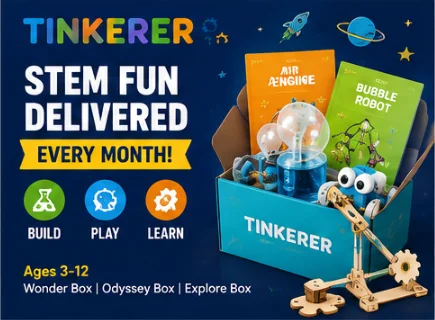
Academics' Choice Award
Tinkerer also highlights recognition from the Academics' Choice Awards.
The company's website features a review of its Infinity Mirror project describing it as an enjoyable STEM activity that helped children explore concepts such as gravity, pulleys, and engineering, while also connecting with engineering standards.
Awards and reviews shouldn't be the only reason to purchase an educational product.
But they can provide additional context when parents are comparing different options.
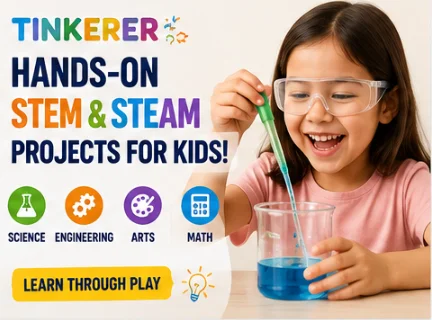
Is Tinkerer Box Worth It?
For parents looking for a subscription box that combines education with hands-on creativity, Tinkerer is an interesting option.
Its strongest points are the combination of:
-
STEM education
-
STEAM creativity
-
Hands-on building
-
Age-specific projects
-
Science experiments
-
Engineering activities
-
Educational magazines
-
Online instructions
-
New projects over time
The biggest appeal is simple:
Children aren't just learning about something. They're doing something.
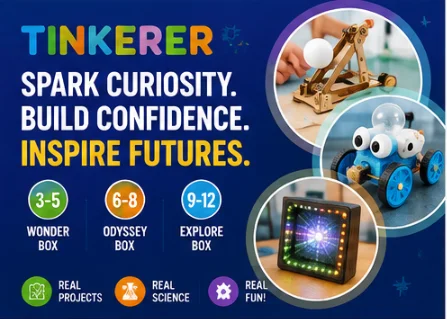
Who Is Tinkerer Box Best For?
Tinkerer may be particularly suitable for families with children who:
-
Love building things
-
Ask lots of questions
-
Enjoy experiments
-
Like science
-
Are interested in engineering
-
Enjoy arts and crafts
-
Need more screen-free activities
-
Like discovering how things work
-
Enjoy hands-on learning
It can also be a thoughtful gift for birthdays, holidays, or other occasions when you want to give a child something more meaningful than another ordinary toy.
Things Parents Should Consider Before Subscribing
No educational product is perfect for every child.
Before subscribing, consider:
Your Child's Age
Choose the appropriate Tinkerer product line.
Your Child's Interests
Some children love building and experimenting.
Others may prefer books, sports, or imaginative play.
Available Space
Some projects require a table or dedicated workspace.
Parent Involvement
Depending on age and project complexity, some activities may benefit from adult assistance.
Subscription Terms
Always review the current subscription, billing, cancellation, shipping, and delivery conditions before purchasing.
These small details can make a big difference to your overall experience.
Tinkerer Box as a Gift
A subscription box can be an especially memorable gift because the experience doesn't necessarily end after one day.
Instead of giving a child a single toy, you're giving them a series of opportunities to:
Build.
Explore.
Experiment.
Learn.
Create.
For children who love science and making things, that can be far more exciting than receiving another conventional toy.
Why Hands-On STEM Learning Matters
The world children will enter as adults will continue to become more technologically advanced.
Artificial intelligence.
Robotics.
Engineering.
Automation.
Biotechnology.
Digital design.
Scientific innovation.
Children don't necessarily need to become engineers or scientists.
But learning how to experiment, think critically, solve problems, and understand cause and effect can benefit almost any future career.
That's why hands-on STEM education is so valuable.
It isn't just about memorizing scientific facts.
It's about learning how to think.
Final Thoughts: Is Tinkerer Box a Good Choice?
Tinkerer takes a simple idea and makes it surprisingly powerful:
Let children learn by making things.
Instead of giving them another screen or another finished toy, Tinkerer gives children projects that ask them to participate.
Build a hydraulic arm.
Create an infinity mirror.
Experiment with light.
Make a bubble robot.
Explore a chemical reaction.
Build a catapult.
Play with mathematics.
Create music.
The projects change, but the underlying idea stays the same:
Curiosity leads to learning.
With dedicated subscription lines for ages 3–5, 6–8, and 9–12, Tinkerer gives parents a way to choose activities that match their child's age and developmental stage.
And perhaps the most valuable result isn't the finished project.
It's the moment when a child looks at what they've built and says:
"I did it myself."
🎁 Check Tinkerer Box Deals Before You Subscribe
If you're interested in trying Tinkerer for your child, it's worth checking the latest available deals before subscribing.
You can find the Tinkerer Box offer page on Dealnory here:
[Explore Tinkerer Box Deals on Dealnory]
Check the current offer, coupon information, subscription details, and availability before completing your purchase.
Subscription prices, offers, shipping policies, product availability, and terms can change. Always check the latest information before purchasing.