SOFTWARE & SAAS · 5 MIN READ
Cloro Review: One API for Google Search and the AI Search Engines
Aug 22, 2026 · 9.9K views
Search is changing fast.
Traditional Google rankings are still important, but users now ask questions directly to ChatGPT, Perplexity, Gemini, Copilot, and other AI-powered search experiences. For businesses, SEO teams, agencies, and developers, this creates a new challenge: how do you track visibility across so many search engines without building a separate integration for each platform?
That is where Cloro comes in.
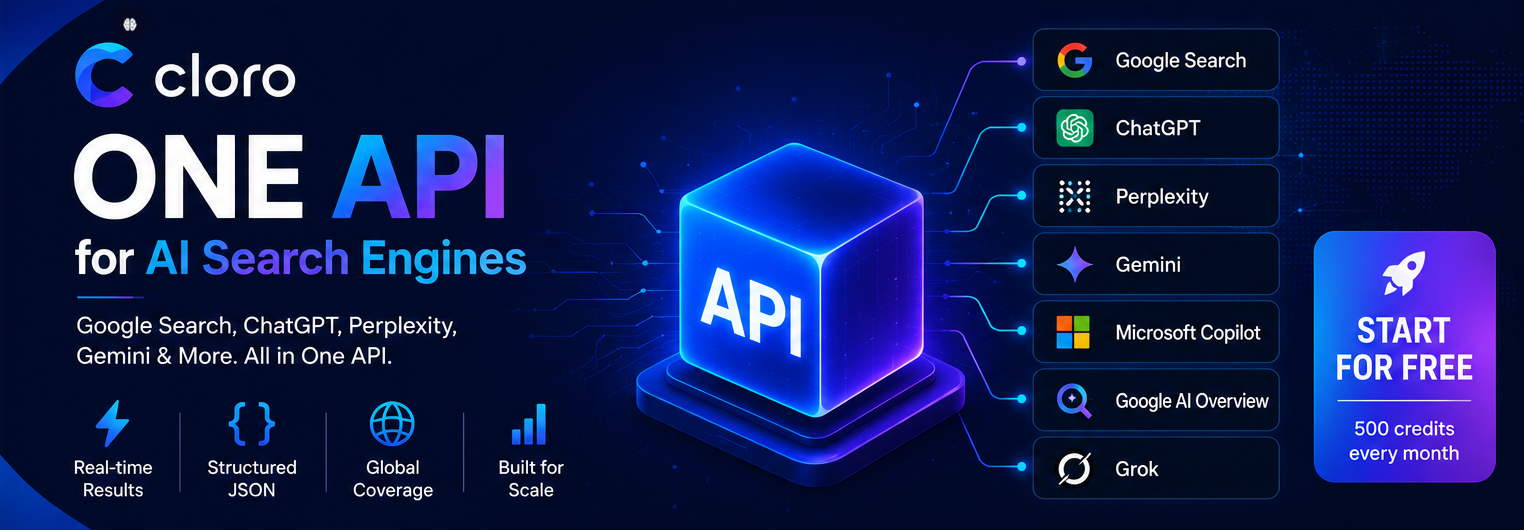
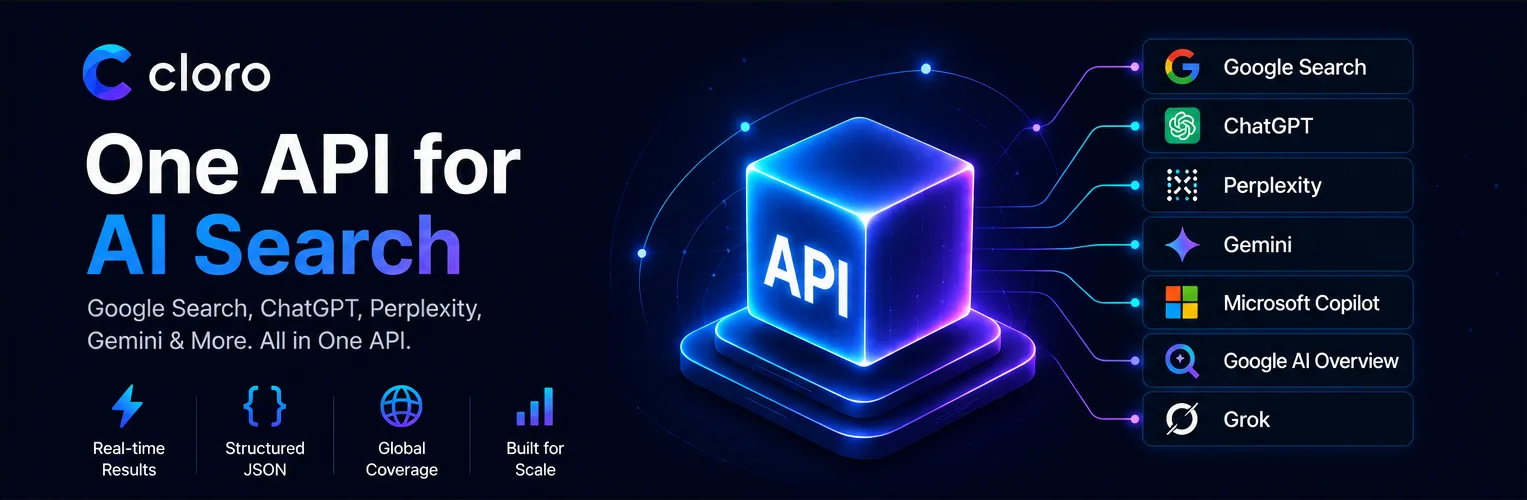
Cloro is a search and AI search API designed to collect structured data from Google Search and major AI search experiences through a single platform. Instead of managing multiple providers and different response formats, developers can use one API to monitor search results, AI answers, citations, and other search visibility signals.
What Is Cloro?
Cloro positions itself as “the search API for the AI era.” The platform provides real-time structured JSON data from Google Search and several AI search providers, making it useful for both SEO monitoring and building search-powered applications.
The supported ecosystem includes:
-
Google Search
-
Google News
-
ChatGPT
-
Perplexity
-
Gemini
-
Microsoft Copilot
-
Google AI Mode
-
Google AI Overview
-
Grok
Instead of learning a completely different API workflow for every provider, Cloro aims to centralize the data collection process into a single infrastructure layer.
Why AI Search Tracking Matters More Than Ever
A website can rank well in Google Search but still have limited visibility inside AI-generated answers.
For example, when someone asks an AI assistant:
“What are the best email marketing tools for small businesses?”
The answer may mention several brands, cite specific websites, or recommend products without showing the same ranking structure as a traditional Google results page.
This means modern search visibility is no longer just about tracking:
Keyword → Position → Clicks
It is increasingly about:
Query → AI Answer → Brand Mention → Citation → Visibility
Cloro helps developers and SEO teams collect this type of data programmatically and at scale.
One API Instead of Multiple Search Integrations
One of Cloro's strongest advantages is consolidation.
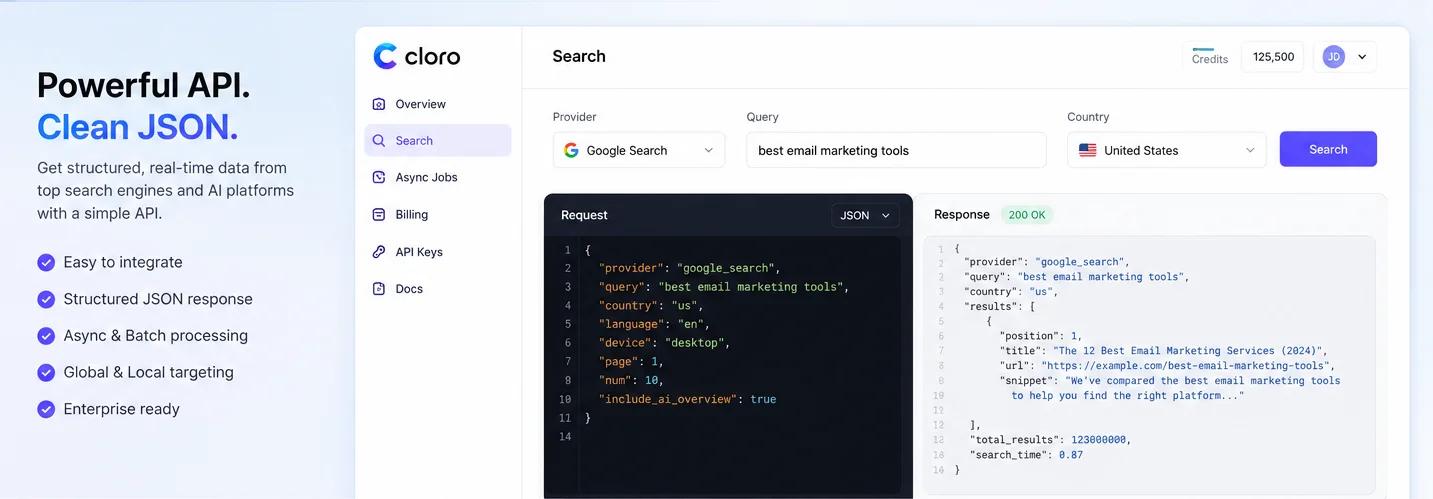
Building directly against multiple search and AI platforms can mean dealing with different authentication systems, response formats, rate limits, and infrastructure. Cloro provides a single API layer that can be used across multiple engines.
The platform also supports structured JSON output, which can be useful for:
-
AI visibility tracking
-
Rank tracking platforms
-
SEO dashboards
-
Competitive intelligence tools
-
Search monitoring software
-
AI agents
-
Custom search applications
-
Automated reporting systems
For developers building products around search data, a unified API can significantly reduce integration complexity.
Track AI Visibility Across Different Markets
Search results are not the same everywhere.
A query performed in the United States can produce different results from the same query performed in the United Kingdom, Germany, Australia, or another country.
Cloro supports geographic targeting across countries, with additional US state-level targeting available for certain AI engines. This makes the platform useful for international SEO monitoring and multi-market analysis.
For agencies and global businesses, this can help answer questions such as:
-
Does our brand appear in AI answers in the US?
-
Which competitors are cited in the UK?
-
How does Google Search visibility differ by market?
-
Which content is appearing in AI-generated recommendations?
Built for Scale
Cloro is not only designed for occasional manual checks.
The platform supports asynchronous requests and batch processing, allowing larger volumes of search queries to be processed without requiring every request to remain open. Its documentation also describes retry mechanisms and concurrency limits based on subscription plans.
This makes it more suitable for projects that need to monitor hundreds or thousands of keywords, prompts, or search queries.
Potential use cases include:
1. AI SEO Platforms
Build dashboards that show whether a brand appears in ChatGPT, Perplexity, Gemini, or other AI search experiences.
2. SEO Agencies
Monitor client visibility across both traditional and AI-powered search engines.
3. Competitive Intelligence
Compare brand mentions and citations against competitors across different search platforms.
4. AI Agents
Give applications and agents access to fresh web and search data through an API.
5. Custom Search Products
Build tools that combine Google search results and AI-generated search responses into a single product experience.
Cloro Pricing: Is It Flexible?
Cloro uses a credit-based subscription model.
The platform currently offers a free tier with 500 credits per month, making it possible to test the service before committing to a paid plan. Paid plans start from $30 per month for 37,500 credits, while larger plans provide lower per-credit costs and higher concurrency limits.
Some of the available tiers include:
| Plan | Monthly Price | Credits |
|---|---|---|
| Free | $0 | 500 |
| Lite | $30 | 37,500 |
| Hobby | $100 | 250,000 |
| Starter | $250 | 650,000 |
| Growth | $500 | 1,350,000 |
| Business | $1,000 | 2,800,000 |
The number of credits consumed depends on the provider and type of request. For example, different credit costs apply to Google Search, Perplexity, Gemini, ChatGPT, and other supported services.
For a detailed breakdown of plans and credit usage, visit:
A Good Starting Point: The Free Plan
For developers who simply want to test the API, the free plan is a practical entry point.
You can evaluate:
-
Response quality
-
Supported providers
-
API structure
-
Latency
-
Geographic coverage
-
Data available from different search engines
Cloro states that new accounts can start with 500 free monthly credits, allowing users to test the platform before selecting a larger plan.
If you want to create an account and test the platform:
Who Should Use Cloro?
Cloro may be especially useful for:
SEO professionals who want to move beyond traditional keyword rankings.
Developers building search-powered products or AI applications.
Agencies managing search visibility across multiple clients and countries.
SaaS companies building rank trackers, AI visibility tools, or competitive intelligence platforms.
AI product teams that need structured search data from multiple providers without maintaining separate integrations.
The Future of SEO Is Bigger Than Google Rankings
Google is still a critical part of search. But the way people discover information is expanding.
Users increasingly ask AI assistants for recommendations, comparisons, research, and answers. As a result, businesses need to understand not only where they rank on Google but also whether AI systems mention, cite, or recommend them.
That is the opportunity behind platforms like Cloro.
By bringing Google Search and multiple AI search engines into one API, Cloro provides developers and SEO teams with a centralized way to collect and analyze modern search visibility data.
For anyone building in SEO, AI SEO, search intelligence, or AI-powered applications, it is worth exploring.
Final Thoughts
Cloro is built for a new generation of search data.
Rather than treating AI search as a separate experiment, the platform brings traditional search and AI-powered search experiences into one infrastructure layer. With structured JSON responses, geographic targeting, async processing, and scalable credit plans, it can be a useful option for teams that need search data programmatically.
The best way to evaluate it is to test the platform with real queries relevant to your business.
Start with the free credits, compare the data across different AI engines, and see how Cloro fits into your SEO or product workflow.
Disclosure: This article contains referral links. If you sign up or purchase through these links, the publisher may earn a commission at no additional cost to you.