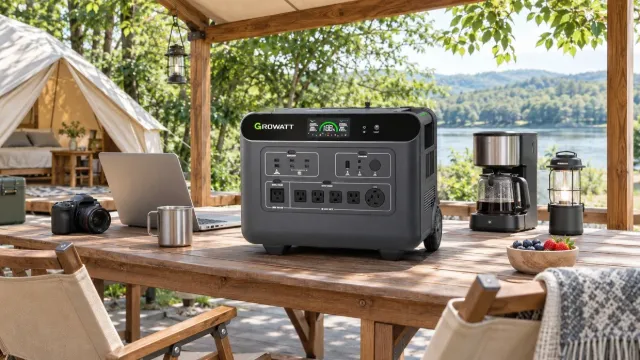
ELECTRONICS & TECHNOLOGY · 7 MIN READ
EcoFlow Review: Power Stations & Home Batteries
Nov 04, 2026 · 13K views
In this article
- EcoFlow review: choose the category first
- Watts and watt-hours answer different questions
- Portable stations versus home batteries
- Charging, solar and expansion costs
- Home-energy savings need your own numbers
- Warranty: match the model and purchase market
- Returns and the selected-product trial
- Buying through Dealnory
- Our assessment
EcoFlow review: compare portable power stations, home batteries, capacity, expansion and Dutch-store return terms before choosing a system for your needs.
EcoFlow sells products that solve different energy problems. A small portable station for a router or a day outdoors is a different purchase from a home battery intended to shift household electricity use. The brand name alone does not tell you whether a particular product can support the appliances, location or operating pattern you have in mind.
This review examines official Netherlands-store information checked on November 4, 2026. Our affiliate destination is the Dutch campaign, so the shopping-policy discussion concerns that market. We have not measured runtime, tested an installation or placed an order. Dealnory may earn a commission through our links at no extra cost to you. Check EcoFlow offers on Dealnory after deciding which product category fits.
EcoFlow review: choose the category first
Begin with one clear job. Do you want a portable supply for a few small devices, a larger station for longer use, or a home energy-storage system? Listing those as separate tasks avoids buying a large stationary product when portability matters, or expecting a small portable station to run a household.
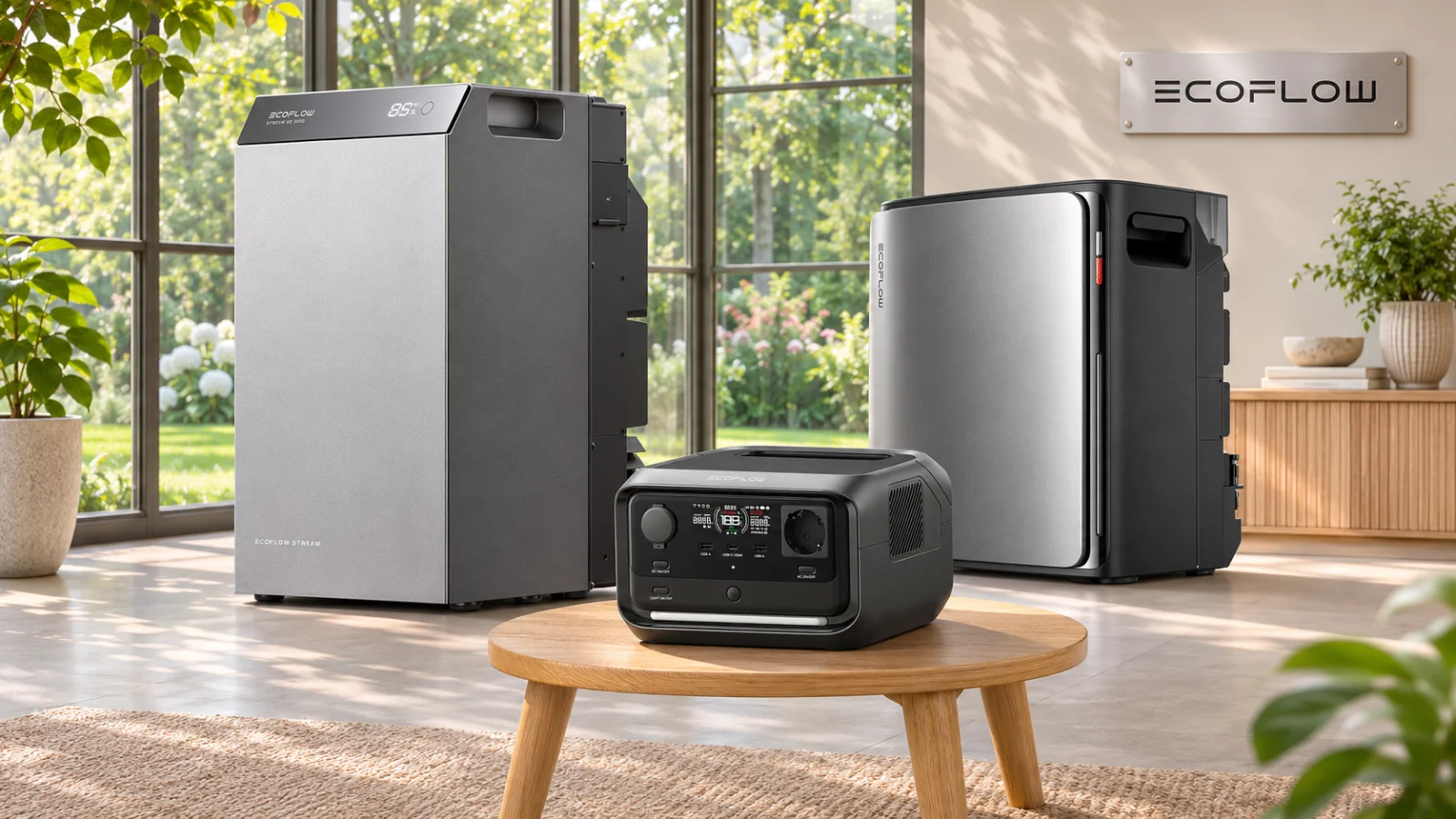
The official range includes RIVER portable power stations and STREAM home-battery products. DELTA is another power-station family, but model names and generations need individual checking. Accessories and extra batteries are not automatically complete stand-alone substitutes for the main product pictured beside them.
The Dutch RIVER 3 page lists the RIVER 3 at 245 Wh and 300 W nominal output, and RIVER 3 Plus at 286 Wh and 600 W nominal output. It describes expansion of the Plus to 858 Wh with an appropriate extra battery. These are manufacturer specifications, not our test results. Confirm the exact selected variant before using them in a purchase comparison.
Watts and watt-hours answer different questions
Output in watts describes the load a system can supply under its specified conditions. Capacity in watt-hours describes stored energy. A high output number does not mean a small battery will run a demanding appliance for a long time. Both figures matter, and neither should be inferred from the other.
As a planning illustration, a hypothetical 500 Wh usable energy budget supporting a constant 50 W load corresponds to ten hours before allowing for any additional losses or operating overhead. If 500 Wh is the advertised nominal battery capacity instead, you cannot assume all of it reaches the appliance. We are not asserting a particular conversion efficiency for EcoFlow.
Measure or obtain reliable consumption information for your own equipment. A refrigerator cycles on and off; a desktop computer changes consumption with workload. Startup requirements can differ from steady operation. A product page showing an example appliance does not prove that every appliance in that category is compatible.
EcoFlow also advertises X-Boost figures on some portable stations. Keep those separate from nominal output and consult the product's compatibility limitations. Do not use the larger promotional figure as a blanket promise that any device with that wattage will operate normally.
Portable stations versus home batteries
The reviewed STREAM AC 5000 listing presents a home battery in the approximately 5 kWh category, with expansion and system configurations. That makes it a different buying decision from a compact RIVER station. Check whether a quoted capacity describes one unit, a bundle with an expansion battery or a larger multi-unit configuration.
The same page has several bundle options. A price beside one bundle should not be compared with the capacity of another. List each included main unit, extra battery, meter and accessory before calculating value. Treat any pictured equipment as illustrative until the selected package confirms it is included.
A battery used for household energy management should not automatically be treated as whole-home backup during an outage. Ask what remains powered when the grid fails, which outputs work independently, whether switching equipment is needed and what installation is required for that exact configuration. Obtain qualified installation advice for connections to household circuits.
For a portable unit, consider weight, lifting, storage and the location of its ports. A station can be compact enough for a car and still be inconvenient to carry regularly. For stationary equipment, check the manufacturer's location, clearance and environmental requirements before deciding where it belongs.
Charging, solar and expansion costs
Charging time depends on the input source and the selected product. An advertised solar-input maximum is not a guarantee that a panel produces that power throughout the day. Orientation, shading, temperature and weather affect available solar energy. Evaluate charging against the energy you expect to use, rather than treating a small panel as an unlimited supply.
Check approved electrical input limits, connectors and required cables for the exact model. Panels, adapters and batteries sold under the same brand are not automatically compatible in every combination. Follow the manufacturer's instructions; this review does not provide wiring or household electrical installation instructions.
Expansion can be valuable if you expect your needs to grow, but identify the approved battery model and maximum supported configuration. Compare the price of a complete larger system with the smaller unit plus its intended extra battery. Also ask whether accessories would need replacement when moving to another product generation.
Home-energy savings need your own numbers
A home-battery savings headline is based on assumptions about energy use, tariffs, charging and discharging. It is not a personal savings guarantee. Start with your own electricity consumption and contract, then ask which assumptions the store's estimate uses and whether they resemble your household.
A simple payback illustration divides total system cost by an assumed annual saving. A hypothetical system costing 2,000 with 200 annual savings would take ten years to recover that initial amount before other costs or changes. Neither number is a current EcoFlow quote or forecast. Real outcomes can change with tariffs, usage, losses, operating costs and battery ageing.
Avoid counting the same benefit twice, such as treating stored solar energy as both free consumption and an additional separate saving without a consistent baseline. If the decision only works under the most optimistic scenario, obtain a more conservative estimate before committing to the system.
Warranty: match the model and purchase market
The Netherlands warranty table lists five years for RIVER 3 Plus variants and several DELTA 3 products, while RIVER 3 is listed at 24 months. Warranty periods differ across products and accessories. Check the current entry for your exact item, any registration requirement and the applicable purchase channel.
A warranty term does not establish battery runtime, a guaranteed electricity saving or unconditional replacement for every problem. Read the coverage, exclusions and service process, and retain proof of purchase and product identification. If buying a bundle, check each component rather than applying the longest advertised term to everything.
Use the policy for the region where you buy. US shipping charges, service arrangements or return periods should not be imported into a Netherlands-store review. If you intend to move the equipment to another country, ask the seller about service availability and electrical compatibility beforehand.
Returns and the selected-product trial
The Dutch refund page describes a 30-day return-request window after receipt for eligible direct-store EU orders. For non-defective returns it lists payment-processing charges plus return shipping. Its Netherlands table lists different shipping amounts for product categories, so obtain the applicable total for your selected items before relying on a refund estimate.
A separate 60-day trial page applies to selected STREAM products, including STREAM AC 5000, Ultra, Ultra X and AC Pro. It is not a blanket 60-day policy for every EcoFlow product. The page's summary mentions processing fees, while its detailed section says those fees are waived for qualifying good-condition returns, with return shipping still payable. Ask support to confirm which terms apply to your order.
That trial also describes an approval and RMA process, and potential deductions for depreciation beyond normal inspection. Keep the packaging and all accessories, and obtain the seller's safe return instructions before sending a large lithium-battery product. A prepaid label does not by itself mean the return is free.
Buying through Dealnory
Compare the complete bundle price after discounts with the exact components you need. A cheaper headline option may omit an expansion battery, panel or installation-related item that appears elsewhere on the page. Verify stock and dispatch estimates for each component if a bundle ships separately.
Browse EcoFlow through our Netherlands affiliate link and confirm the destination, selected variant and final checkout total. Coupon conditions can change. Do not assume that a promotional saving, credit or trial applies to every product.
Our assessment
EcoFlow merits comparison when you can define the load, operating time and charging arrangement you need. Its different product families make that definition essential: a compact portable station and a household storage system should be evaluated against different jobs and total costs.
Shortlist the appropriate category, verify compatibility and calculate the complete price before applying a coupon. For a home system, confirm installation and outage behaviour; for portable use, check actual load and carrying practicality. Our assessment remains a review of published specifications and purchasing terms, with no claim of independently tested performance.