In this article
- Jackery review: who should consider it?
- Compare product families before comparing discounts
- Capacity and output answer different questions
- Solar bundles: useful flexibility with setup constraints
- Calculate the complete cost of the setup
- Returns and the practical cost of changing your mind
- Warranty, storage and ownership checks
- Verdict: buy around a verified load and exact model
Jackery review: compare portable power needs, solar kit costs, charging limits and return rules before choosing stations for camping or backup use at home.
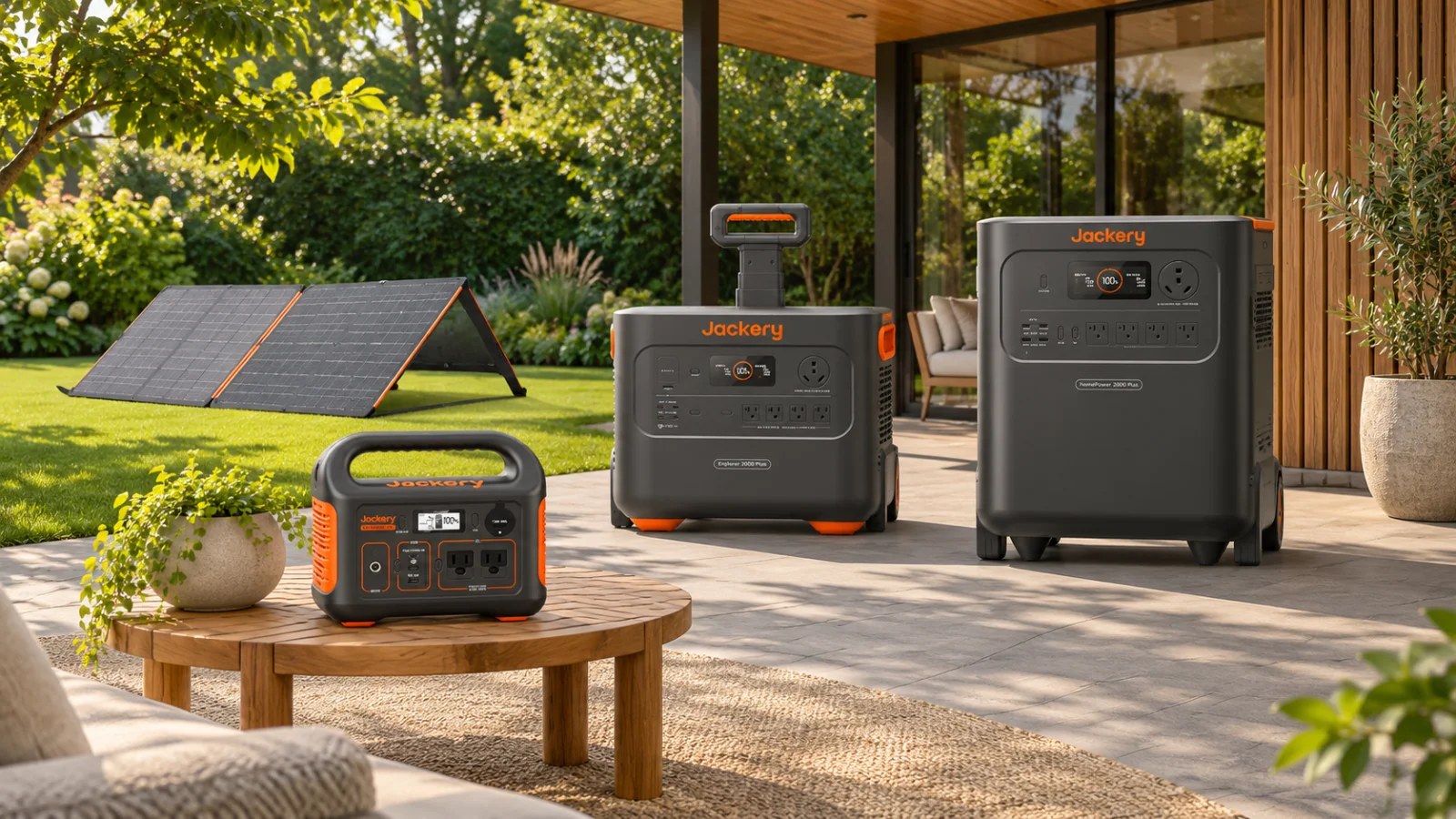
Jackery sells portable power stations and solar generator bundles across several size classes. The useful question is not simply which box has the largest number on its label. It is whether the particular model can run your equipment, store enough energy for your intended period and recharge under the conditions you actually have. This review is based on official product and support information checked in November 2026, plus buying calculations. We have not conducted a hands-on runtime, charging or durability test. The cover is an AI-assisted product-range illustration based on official product references, not a photograph of our own testing.
Affiliate disclosure: Dealnory may earn a commission when you buy through our affiliate link. Check the Jackery deals page for offers, then browse Jackery through our affiliate link to confirm the current model, bundle contents and delivered price.
Jackery review: who should consider it?
Jackery is worth considering if you want a packaged battery power system for portable electronics, selected camping equipment or a defined backup load. Its range makes it possible to compare a compact carryable unit with larger systems without immediately committing to a permanently installed arrangement. However, a portable station still requires planning. Capacity, output, charging inputs, physical weight and the exact accessories supplied matter more than a broad promise of emergency readiness.
Start with a short list of essential devices. A person charging phones and camera batteries has a different requirement from someone expecting to run a cooking appliance. A larger station may provide useful headroom, but it can also become inconvenient to lift, store or transport. Buyers seeking automatic whole-home operation need to investigate a specifically supported installation and qualified professional advice. A portable battery sitting beside a wall socket does not by itself establish that capability.
Compare product families before comparing discounts
| Shopping category | What to evaluate | Main compromise |
|---|---|---|
| Compact Explorer station | Carry weight, ports and energy needed for personal electronics | Less stored energy for repeated or sustained use |
| Larger Explorer station | Continuous output, startup demands, transport and recharging | More weight and a larger purchase commitment |
| Expandable or HomePower system | Exact supported batteries, accessories and intended configuration | Additional components can increase total cost substantially |
| Solar generator bundle | Station plus specified panels, cables and input compatibility | Panel performance depends on actual sunlight and setup |
The official range includes Explorer 300, Explorer 2000 Plus and HomePower products, alongside other generations and bundles. Similar names are easy to confuse. Treat “Plus,” “v2,” and other suffixes as part of the model identity. Do not borrow a capacity, weight, battery chemistry, charging speed or warranty from a similarly named listing. Save the full product name and its specification sheet before comparing retailers or applying an offer.
Capacity and output answer different questions
Watt-hours describe stored energy, while watts describe power delivery. A high-capacity battery can still be unsuitable if the equipment demands more output than the station supports. Equally, sufficient output does not mean the battery will run that equipment for an entire evening. Look at both the continuous output rating and any relevant startup requirement, rather than treating a promotional peak figure as a normal operating allowance.
For an illustrative calculation, a hypothetical 1,000Wh battery powering a steady 100W load has an ideal arithmetic runtime of ten hours. That is not a Jackery test result or a promise for any model. Conversion losses, the station's own consumption, operating conditions and the connected device's changing demand reduce or alter practical runtime. A refrigerator cycles; a laptop's charging demand changes. Measure or obtain a credible load estimate before spending money around a runtime assumption.
Also examine how power is divided across ports. The presence of several sockets does not mean each can supply the full headline output simultaneously. Check the manual for the specific AC, USB and DC combinations you expect to use. Device compatibility should be established before checkout, especially when interruption would have serious consequences.
Solar bundles: useful flexibility with setup constraints
A solar generator bundle combines storage with a way to replenish it from compatible panels. Compare the exact included panel model, number of panels, cable lengths and connector requirements. A photograph showing a panel beside a station does not establish that the panel is included in the selected purchase option. Read the cart description and included-items section together.
Panel wattage is not a promise of constant charging power throughout the day. Shade, cloud, angle, temperature and available daylight change the energy collected. Plan where the panel can face useful sun while the station remains in conditions permitted by its manual. Do not assume the station and panel have identical weather protection. A sunny garden illustration should not be interpreted as permission to leave every component exposed to rain.
Fast charging claims deserve the same careful reading. Compare the charging mode, starting percentage, input source and conditions attached to the stated time. A fast wall-charge claim does not establish the speed of a small solar bundle. If a short recharge window is essential, choose around the charging arrangement you can actually provide.
Calculate the complete cost of the setup
Write down a complete basket: station, any solar panels, any expansion battery, required adapters or cables, delivery and applicable taxes. Compare that basket with a bundle containing equivalent components. A station-only sale can look cheaper until the missing equipment is added. Expansion should also be checked against the exact supported model; a shared brand name does not guarantee that every battery or accessory works together.
Discounts are most useful after the load and configuration are settled. Avoid choosing an oversized system simply because its advertised saving is larger. Conversely, buying a smaller system that fails your essential load can be more expensive than making the right purchase once. Keep a copy of the cart contents and promotion conditions so you can distinguish a temporary price from a permanent specification.
Returns and the practical cost of changing your mind
Jackery's official return policy, updated October 15, 2026, provides a 30-day window from delivery for purchases through its website and Jackery Amazon Store. Other retailers have their own rules. Custom-configured or branded orders are excluded. Obtain an RMA before sending a return. The policy requires shipment within 15 days after receiving that authorization and asks buyers to retain packaging and return all supplied components.
Original condition matters: restocking deductions can apply otherwise. Jackery covers return shipping for defects, delayed shipping or damaged packages; other reasons can incur shipping and handling deductions. Ask support for the amount before returning a heavy system. A prepaid label alone does not establish that a change-of-mind return has no cost.
Warranty, storage and ownership checks
Read the warranty attached to the exact SKU and sales channel, including registration requirements, coverage period, exclusions and the process for making a claim. Do not assume a headline warranty banner covers every accessory for the same period. Keep proof of purchase, serial details and the relevant manual somewhere you can access if the station itself is unavailable.
Follow the model's instructions for storage temperature, charging, ventilation and maintenance. Before a planned trip, check charge levels and confirm your equipment works in the intended configuration. For household backup, make a written device priority list and keep it realistic. The value of a system depends partly on whether the people who will use it can move it and operate it confidently.
Verdict: buy around a verified load and exact model
Jackery offers a broad enough range to merit comparison for portable power, but the strongest buying decision begins with your equipment and recharge plan. Confirm exact model identity, usable ports, required accessories, lifting practicality and the financial consequences of a return. Then compare the delivered price of equivalent packages. For current offers, visit Jackery on Dealnory and use our Jackery affiliate shopping link to review the final configuration.