HOME & GARDEN · 4 MIN READ
Tennessee Wholesale Nursery Review: Should Home Gardeners Buy Bare-Root Plants in Bulk?
Nov 02, 2026 · 1 views
In this article
Planting a hedge, a native meadow or a small orchard can mean buying dozens of plants, and garden centre prices add up quickly at that scale. Bulk bare-root stock is the traditional answer. Tennessee Wholesale Nursery sells bare-root trees, shrubs, perennials, ferns, seedlings, live stakes and erosion-control plants from a Tennessee farm, mostly in packs of 25 or more, with landscapers, contractors and garden centres as core customers.
I would judge a wholesale nursery from a home gardener's point of view on three things: whether the pack sizes match your project, whether you understand how bare-root stock arrives, and what protection you have if plants fail. The last point is unusually important here.
Pack sizes and prices
Prices are set by the pack. A 25-pack of 1 to 2-foot pawpaw trees was listed at $149, about $5.96 each, and 25 pawpaw seedlings of 6 to 12 inches at $49.99, about $2 each. Fruit trees were also sold in 25-packs, with apple at $319.99, peach at $269, fruiting plum at $312, apricot at $319, persimmon at $109 and mulberry at $129. Bare-root perennials, ferns and native plants were listed at around $44.99 for 25, with volume tiers bringing the price down to about $1 a plant at 100.
Those per-plant prices are low, but a 25-pack is a lot for a small garden. Neighbours or community projects can share an order.
Understanding bare-root stock
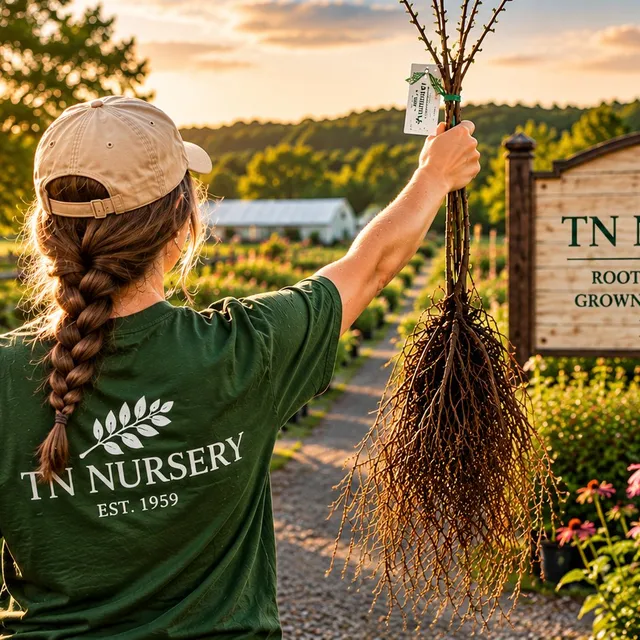
Bare-root plants arrive without soil, typically dormant, and need planting promptly. Trees, shrubs and conifers ship in the dormant season, and the pawpaw listings showed a shipping date of November 2026. Roots are dipped in a moisture-retaining gel, which the shipping page says protects plants in transit for up to twelve days, while another line on the same page says plants are fine in their packages for up to three days after arrival. I would plan to plant within a day or two.
Pawpaws suit zones 5 to 9. The listing notes that two or more are needed for fruit and that first fruit comes after three to four years, while mature height is described as both under 25 feet and 15 to 30 feet.
The warranty only covers licensed resellers
This is the detail home gardeners must read. The warranty page offers an Arrive Alive guarantee with a 24-hour reporting window from delivery, requiring photos by phone and email, with no exceptions. However, it also states that customers without a wholesale reseller licence receive no warranty at all. That contrasts with homepage wording that welcomes home gardeners.
In practice, a home gardener buying without a licence takes on the risk of losses. I would order only what I could plant immediately and inspect everything the moment it arrives.
Shipping costs
Plants ship by US Priority Mail, with tracking sent on dispatch. Shipping is estimated at checkout, and the policy says a carrier-cost difference may be charged later. A banner advertises free shipping on orders of $750 and up, which is aimed at commercial buyers. For smaller orders, shipping can be a significant share of the total, so check it before paying.
Refund and shipping policy pages were linked but not read, so I could not confirm general return terms.
Is bulk buying sensible for a home garden?
It can be, for the right project. A native hedge, a woodland edge, a wildlife meadow or erosion control on a slope can easily use 25 or more plants, and bare-root stock establishes well when planted in the dormant season. For a single feature tree, a local nursery with a warranty is usually the safer option.
For illustration, 25 bare-root perennials at $44.99 cost about $1.80 each. Even if a fifth fail, the surviving plants work out to around $2.25 each, still well below typical potted prices. That is a budgeting example, not a survival guarantee.
My verdict
Tennessee Wholesale Nursery offers genuinely low per-plant prices on bare-root natives, fruit trees and perennials, which makes large planting projects affordable. The lack of warranty for non-licensed buyers and the inconsistent handling guidance mean home gardeners carry most of the risk. I have not ordered from the nursery, so plant size, root quality and packaging remain untested here.
If I were ordering, I would choose a project that genuinely needs 25 or more plants, prepare the ground beforehand, be home on delivery day and plant within 24 hours. Bulk plants earn their price when most of them establish and thrive, not when the per-plant figure looks impressively low.
Current coupons and offers
Compare the available offers below against the complete checkout total. Choose a coupon that applies to what you actually need, and check its conditions before paying.
Offers and coupon eligibility depend on the store and the time of purchase. For the latest options, visit the Tennessee Wholesale Nursery offers page on Dealnory.
Sources and disclosure: Tennessee Wholesale Nursery homepage, Shipping and Warranty page, Warranty page, Fruit Trees collection and pawpaw product pages, checked 2 November 2026. This is an editorial assessment of published information, not a hands-on test. Dealnory may earn a commission on qualifying purchases. The cover is an editorial illustration.
Explore Tennessee Wholesale Nursery through our affiliate link
Check the Site for Current Seasonal Promotions
DEAL SALE · No code needed