HOME & KITCHEN · 7 MIN READ
Cutluxe Review: Kitchen Knives, Care & Value
Nov 04, 2026 · 14K views
In this article
- Cutluxe review: what is the range?
- The Artisan chef knife: a useful starting comparison
- Which shape suits the food you prepare?
- Chef knife, santoku or nakiri
- Bread and carving knives
- Handle fit and working space matter
- Care: budget for more than the first purchase
- Single knife or set: compare what you will use
- Warranty, returns and delivery
- Pros and trade-offs
- Cutluxe review: the verdict
- Frequently asked questions
- Does German steel mean the knife is made in Germany?
- Can I put Artisan knives in the dishwasher?
- Is a large knife set always cheaper?
- Does the warranty cover normal dulling?
Cutluxe review: compare kitchen knife shapes, Artisan specifications, handle fit, care and warranty terms before buying a single blade or a set.
A kitchen knife earns its price through the meals you actually prepare. Cutluxe offers general-purpose and specialist blades, but the most useful purchase may be one suitable knife rather than a large matching collection. Start with the job your current tools do poorly, then compare the shape, size and maintenance requirements.
This review assesses published product details checked on November 4, 2026. We have not tested sharpness, edge retention, balance or durability ourselves. Dealnory may earn a commission through our links at no extra cost to you. Check current Cutluxe coupons and offers after choosing the type of knife you need.
Cutluxe review: what is the range?
Cutluxe sells chef knives, vegetable knives, bread knives, carving and slicing knives, smaller utility blades and sets. Its Artisan line is marketed around high-carbon German steel, full-tang construction and Pakkawood handles. The store also sells other series, so a specification for one Artisan product should not automatically be applied to every knife carrying the brand name.
German steel is a material description and does not by itself establish where the finished knife was manufactured. Likewise, an attractive finish or a claim of professional performance does not replace measurements or independent testing. Treat the manufacturer's specifications as a starting point for comparing tools, not proof of a particular result in your kitchen.
The Artisan chef knife: a useful starting comparison
The eight-inch Artisan chef-knife listing describes a full-tang blade, a triple-riveted Pakkawood handle and an edge angle of 14–16 degrees per side. Its main price displayed $54.99 when checked, while an answer lower on the same page referenced a different figure. Confirm the actual cart price rather than relying on an older number embedded in descriptive copy.
For a home cook preparing a mixture of vegetables and boneless ingredients, an all-purpose shape is often the most sensible first comparison. The important questions are whether the length suits your board, whether the handle feels secure and whether you are willing to maintain the blade. A feature list cannot tell us how comfortable it will feel in your own hand.
Which shape suits the food you prepare?
Chef knife, santoku or nakiri
These categories overlap in everyday preparation, but their profiles and lengths can favour different habits. A chef knife is a versatile starting point, while a shorter santoku may appeal to someone who prefers a more compact tool. A nakiri's straighter edge makes it a distinct option for vegetable-focused preparation. Compare the actual shape instead of assuming a Japanese-style name guarantees a preferred feel.
If you already own a comfortable general-purpose knife, another similar blade may add less value than a tool that addresses a genuinely different task. Conversely, replacing one unsuitable daily knife can matter more than adding several specialist pieces you rarely use.
Bread and carving knives
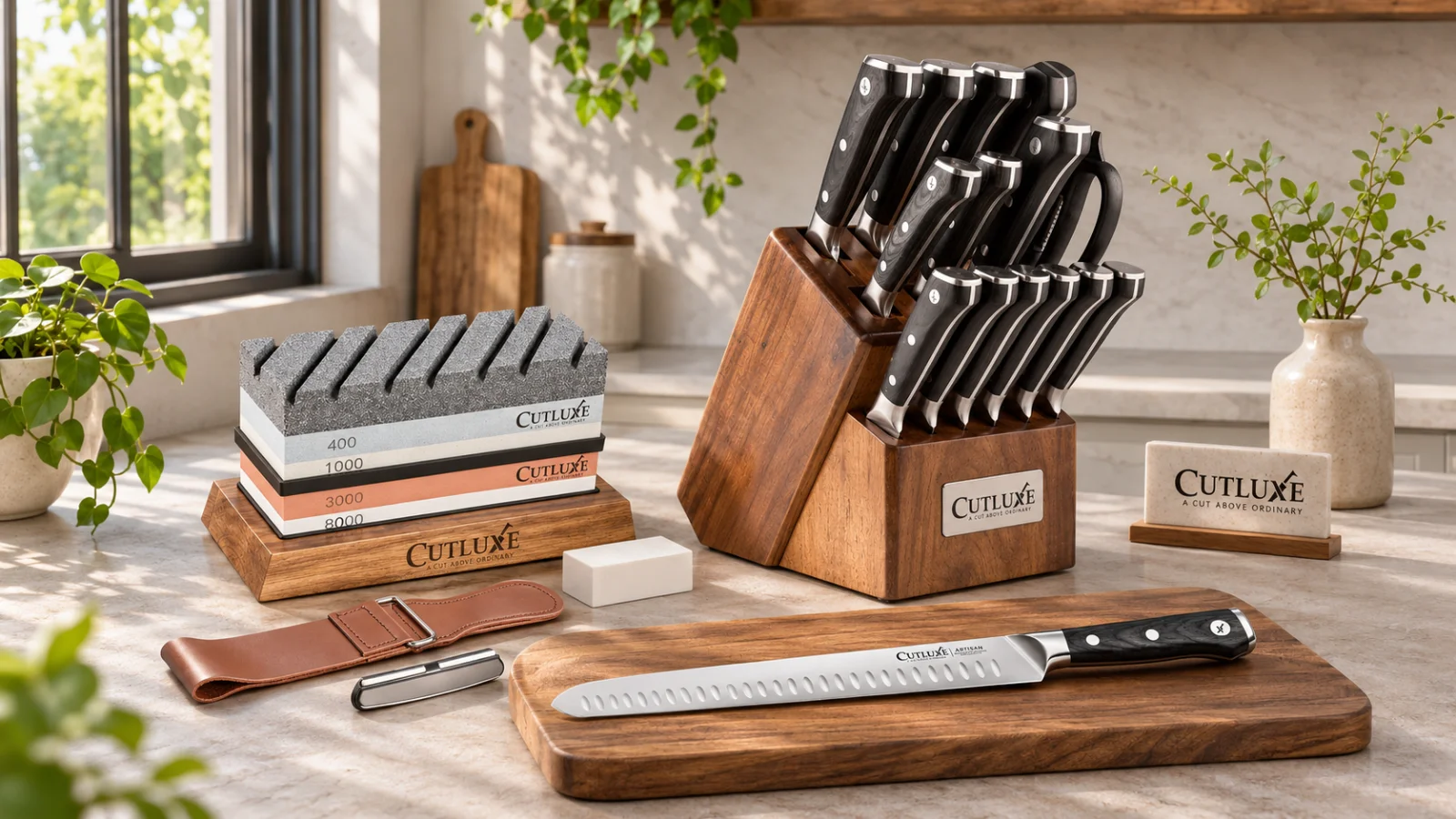
A serrated bread knife and a long carving slicer serve different purposes from a short utility knife. Cutluxe's twelve-inch Artisan slicer is marketed for larger cooked cuts, while its bread range uses serrated blades. Check that the length fits both the food and the workspace. A long slicer needs appropriate storage and enough room to use comfortably.
Do not assume that every broad blade or product labelled cleaver is suitable for the same heavy work. Different models have different profiles and intended applications. Follow the specific product instructions rather than using appearance as a substitute for suitability.
Handle fit and working space matter
Pakkawood is a wood-and-resin composite rather than an untreated wooden handle. It may appeal if you like a substantial, wood-like finish, but the material name does not establish grip comfort. Look at handle thickness, contours, the transition to the blade and available knuckle clearance.
If you cannot handle the knife before buying, compare its published dimensions with a knife you already use comfortably. Check whether a protective cover or sheath is included and whether the knife will fit your current block. A storage problem is part of the cost of buying a different shape, even if the product itself is discounted.
Also consider who shares the kitchen. A larger handle that feels secure to one person may be awkward for another. If the knife is a gift, ask about the recipient's preferences rather than choosing solely by the look of the packaging or the size of the blade.
Care: budget for more than the first purchase
The manufacturer's care instructions specify hand washing, immediate drying and protected storage. They discourage dishwasher use and recommend suitable wooden or plastic cutting boards. A buyer who wants to leave every utensil in a dishwasher should take that maintenance requirement seriously.
Stain resistance is not the same as being unaffected by prolonged moisture or poor storage. Keep the edge protected from other utensils and follow the care guidance supplied with your exact model. Those ordinary habits are part of owning a reusable kitchen tool rather than evidence that a knife is maintenance-free.
Honing and sharpening are also different tasks. Do not assume an inexpensive accessory will restore every dull or damaged edge, or that a lifetime warranty replaces normal maintenance. If you prefer professional servicing, include its eventual cost and availability when comparing brands.
Single knife or set: compare what you will use
The Artisan three-piece set checked here combines an eight-inch chef knife, a seven-inch santoku and a five-and-a-half-inch utility knife. That may suit someone building a small coordinated selection, but the chef knife and santoku still overlap in many daily tasks. The set is not automatically better value for a cook who only needs one of them.
Write down the missing roles in your kitchen, then price the relevant pieces separately. Count accessories and steak knives honestly when assessing a larger set's advertised number of pieces. A block full of tools you do not need can cost more and occupy more space than a smaller group selected around your meals.
For a fair price comparison, use the same size, series and package contents. A sale on a different collection may involve different materials or handle construction. Read the individual listings rather than treating all Cutluxe knives as interchangeable.
Warranty, returns and delivery
The product information advertises a lifetime warranty against material and workmanship defects and a 30-day money-back or exchange option. The eight-inch chef-knife and utility-knife pages describe those promises, but a warranty against defects does not establish a lifetime of unchanged sharpness or cover every use-related problem.
Before purchase, confirm the current return deadline, eligibility, shipping responsibilities and procedure for your order. Keep proof of purchase and ask support about any ambiguity in the coverage. If ordering for an event or gift, use the current destination-specific delivery estimate rather than a general fast-shipping headline.
Pros and trade-offs
Several useful shapes: the range supports choosing a tool around a particular kitchen task.
Published Artisan specifications: construction, handle and care details provide a basis for comparison.
Single-item options: buyers can upgrade a frequently used knife without committing to a large set.
Comfort remains personal: published features cannot establish hand fit or balance for every user.
Maintenance is required: hand washing, drying and edge care belong in the purchase decision.
Series and price details vary: confirm the exact listing and checkout rather than combining claims from several pages.
Cutluxe review: the verdict
Cutluxe is worth considering if you want to compare an accessible kitchen-knife range and are prepared to care for it. The strongest choice is the shape you will use repeatedly, with a size and handle appropriate for your workspace. We cannot endorse long-term cutting performance without testing, and a sale alone does not settle that question.
Review the latest Cutluxe offer conditions on Dealnory, then compare the final total with equivalent options. If the tool and terms suit your kitchen, shop through our Cutluxe affiliate link.
Frequently asked questions
Does German steel mean the knife is made in Germany?
No. The material description alone does not establish the manufacturing location of the finished product. Ask the seller if origin is important to you.
Can I put Artisan knives in the dishwasher?
The manufacturer specifies hand washing and immediate drying. Follow the instructions for the exact model.
Is a large knife set always cheaper?
Only if it contains the tools you need at a better combined price. Compare useful pieces, storage and maintenance rather than the number printed on the box.
Does the warranty cover normal dulling?
The published warranty concerns material and workmanship defects. Do not treat it as a replacement for normal edge maintenance; confirm coverage with the seller.